

Introduction
India’s air quality challenge is far more complex than what most public conversations suggest. While particulate matter (PM2.5 and PM10) continues to draw the most attention, an equally pressing threat remains largely overlooked: gaseous pollutants, especially VOCs (Volatile Organic Compounds) and NO₂ (Nitrogen Dioxide).
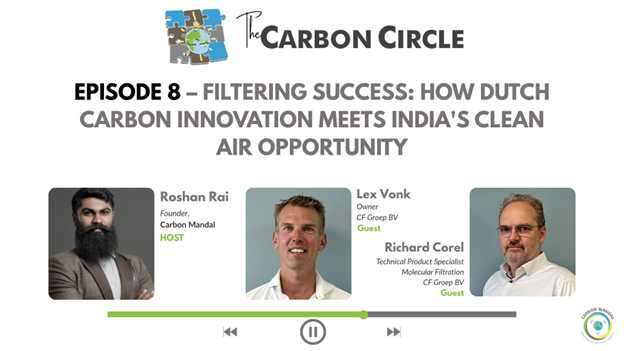
In the latest episode of the Carbon Circle Podcast, experts Lex Vonk and Richard Corel from CF Groep B.V. and Indifil break down why managing these pollutants requires a completely different approach from traditional dust control.
This discussion reveals the true extent of India’s air quality problem and the industries that must focus on moving forward.
Why VOCs & NO₂ Are Different from Dust
Dust and PM2.5 are visible and tangible, making them relatively easier to filter using conventional mechanical systems.
But gaseous pollutants behave differently because:
- They are molecular in size, not particulate
- They penetrate deeper into indoor spaces
- They react chemically with materials and surfaces
- They linger longer, often without detection
- They impact both human health and industrial processes
As Richard Corel explains in the episode:
“When you talk about air pollution, most people think of dust. But VOCs and NO₂ behave completely differently—they need different filtration science altogether.”
This distinction is critical for industries that rely on controlled air environments.
The Science Behind Activated Carbon Filtration
The podcast highlights why activated carbon has become the global standard for removing VOCs, NO₂, and other gaseous contaminants.
How Activated Carbon Works
- Adsorbs pollutants at the molecular level
- Uses a microporous structure to trap gases
- Can be engineered for specific industrial gas contaminants
- Maintains efficiency over extended periods
- Supports sustainable and long-term filtration goals
Different sectors require different carbon formulations, depending on:
- Chemical exposure levels
- Temperature & humidity environments
- Target gases
- Airflow requirements
Lex Vonk explains how Indifil and CF Groep are bringing precision-engineered carbon solutions to India, enabling industries to manage gas pollution efficiently and responsibly.
Industries Driving the Demand in India
The rise of urbanisation, sensitive manufacturing, and indoor-heavy operations has increased demand for gas-phase filtration across:
High-Growth Segments
- Pharmaceutical manufacturing
- Chemical and process industries
- Data centers
- Cold storage and warehousing
- FMCG manufacturing
- Commercial buildings & hospitals
These sectors require more than dust management—they need complete air quality control for:
- Worker safety
- Product quality
- Equipment longevity
- Compliance with global air standards
The Sustainability Edge
The future of filtration is shaped not just by performance but by sustainability.
The episode emphasises:
- Lower energy consumption
- Longer filter life
- Reusable materials
- Reducing environmental impact
- Meeting global sustainability norms
Indifil’s partnership with CF Groep enables India to adopt filtration solutions that match both operational efficiency and environmental responsibility.
Conclusion: India Must Look Beyond Dust
India’s air quality crisis cannot be solved by dust filtration alone. VOCs and NO₂ represent a fast-growing, often invisible threat that industries must address proactively.
Activated carbon filtration is no longer optional—it is essential.
To explore the full depth of this discussion and gain actionable insights for your organisation, watch the complete Carbon Circle Podcast episode with Lex Vonk and Richard Corel.